

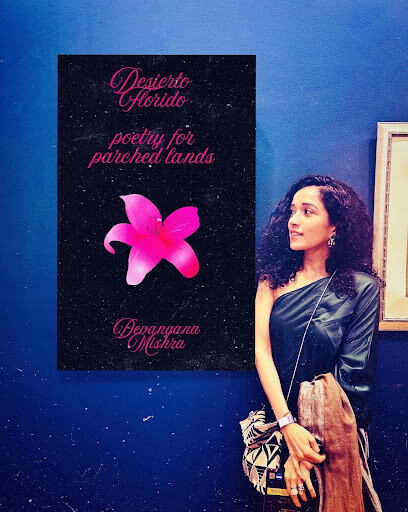
On Mishra’s poetry for Parched Lands from Mumbai, India
There is a point in every summer when the heat stops being weather and becomes a question. The ground cracks, the light flattens, and everything alive starts asking for one soft thing to look at. Chile’s Atacama, the driest desert on Earth, answers that question every few years by bursting, absurdly, into flower. Devangana Mishra has borrowed the miracle for her tiny poetry and art collection, Desierto Florido: Poetry for Parched Lands, and reader, the borrowing is honest. This little book is the flower.
It arrives small, improbable, and exactly when the ground needs it.
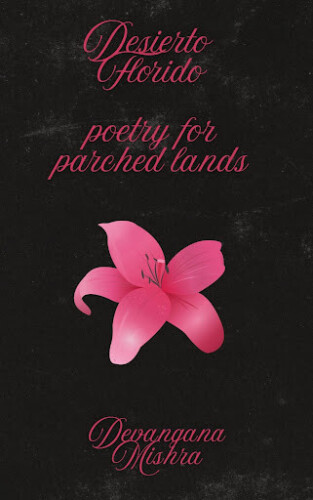
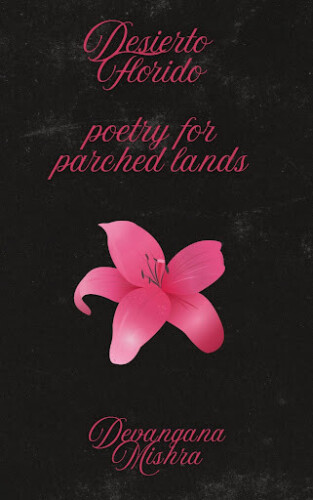
Desierto Florido, a single bloom against parched dark.
Mishra, educator, artist, founder of the autism-inclusion non profit Brain Bristle writes like a painter who distrusts grand canvases, and her mornings are where the brushwork shows. In “Aurora,” a man wakes his beloved by drawing the curtains and calling her my sunshine, and the day itself gets up and starts working for the metaphor: petals of love fallen like butter in soup (a line you will try to dislike and fail), light that filled the pockets of her eyes when she smiled, mornings of rivers in streams of gold, ripples of silk creased boatmen setting swans to lakes, fallen stars to rest, until night. Nothing dramatic happens in this poem. That is the point. Devotion, in Mishra’s world, is not an announcement; it’s a shift you show up for. By noon, it got busy again, all dreamers waited, until dawn: all love as a job with excellent hours.
Then comes the flirtiest interrogation in the book. In “The Quetzal and The Bough,” a woman peppers her lover with the kind of hypotheticals every partner will recognise and every lawyer would object to: if I were the cactus on the bookshelf, a stopper with spokes and stout, would you replace me with a flowering peony? If I were the Polaris, but you woke up at noon? If I were the kite and you suffered vertigo? If I were the door and behind me Sherwood Forest, would you usher me aside for the banyans and the moon? These are unanswerable, and she knows it, and he knows she knows it. So he doesn’t answer. He’d spit a fruit seed to soil. That’s it. That’s the whole defence. And then Mishra lands the image that gives the poem its name: She was the quetzal, with wings of rainbows and him all branches, rested for arrival. If you want a portrait of a good man in eleven words, there it is, all branches, rested for arrival.
Twelve doors away, the theory gets its street-level proof. In “Love is An Osmotic Give and Return,” Mishra watches a couple I don’t know the names of, though the husband buys flowers every Sunday and Thursday, telling the florist: ten for the missus and two for my mettle. And his wife? She slips another back up his sleeve, leaving herself nine. One flower, smuggled back and forth between two people for years. Love is an osmotic give and return, the poem states its thesis in its title and then proves it at a flower stall, which is more than most philosophy manages.
But don’t mistake this for a book that only knows sweetness. Mishra knows exactly what a parched land looks like, because in “On a Bad Day” she draws one…. literally, in art class: I drew it without the sun, rivers dried, few trees around homes with narrow roofs and children underneath, crying. Then comes the line every artist has learned the hard way: What’s once painted, can’t be wiped. She asks for another paper. She waited days for inspiration, she didn’t come by, inspiration, note, is a she, and she is flaky so the poet draws what she can: a calf under a tree. And then the forgiveness: nature has mercy that man doesn’t; it somehow survived.
Every working artist knows this exact sequence, the irreversible first mark, the no-show muse, the humbler second image that turns out to be the true one.
Mishra though had the nerve to write it down.
The collection’s widest lens is “Robert,” where dawn arrives like laundry: soaked in a bucket of tar, now washed clean for tomorrow, though some pigments of night are hard to rinse off; they remain buttons and fine frills at collars. (Anyone who has carried yesterday into a meeting knows those buttons.) The poem swings cheerfully from biology, cells regenerate in our body every few days to years: new skin, new hair, a belly rinsed of bad bile to the whole history of human thought, and then, in its best move, back down to a stranger on the street: A man in a pink shirt with stiff collars passes us by, we call him Robert and watch him live life. We’ve all named a Robert. And then, dropped almost carelessly, the book’s quietest thesis, five words long: Most of life is learned. Renewal, in other words, is practice with curtains drawn, seed spat to soil, flower slipped up a sleeve, second drawing attempted at last.
Painterly, brief and generous, Desierto Florido reads in one sitting and lingers considerably longer. It’s summer; we all need a flower. This one arrives the way deserts actually bloom, by keeping the conditions kind.
Desierto Florido: Poetry for Parched Lands by Devangana Mishra. Poems quoted with the author’s permission. The book is available globally on amazon. Devangana is also the author of the verse novel 26, Kamala Nehru Ridge, Civil Lines, Delhi (2023); and her next work after this, a historical fiction, May I Bombay?, releases summer 2027.
© 2026, Logan. All rights reserved.
